
Communications course at COMPLIT
Admissions Open

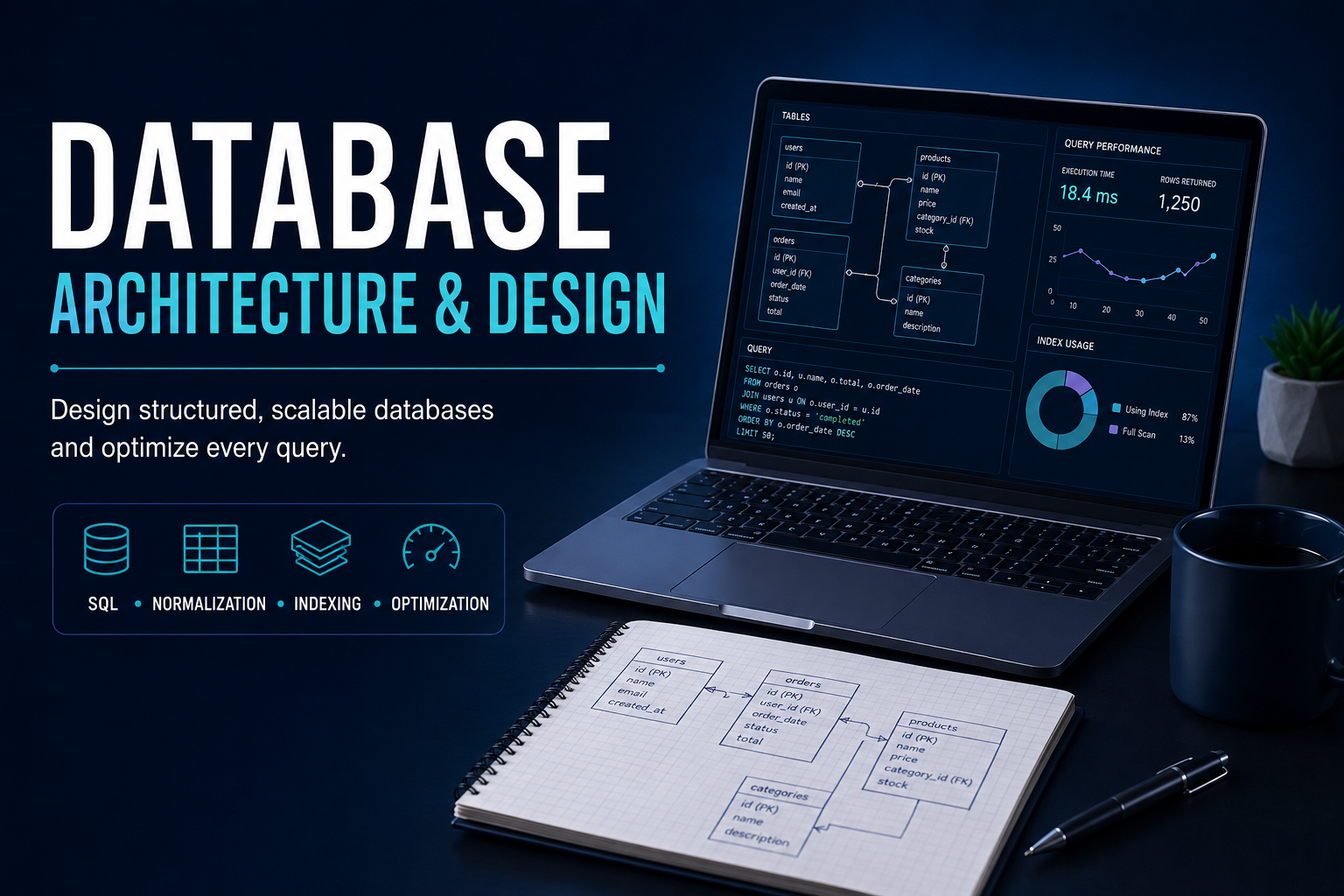
Database Architecture & Design

Relational database design, normalization, indexing, and query optimization.

Duration3 Months
Learning modeMentor-guided online
Course fee₹15,000
Enroll Now

Apply online, complete payment, and begin learning through your student account.

Have questions? Chat with us on WhatsApp first

Practical learningBuild skills through guided assignments
Mentor guidedStructured feedback as you progress
Flexible accessManage lessons through your portal

About this course

Relational database design, normalization, indexing, and query optimization. Across 12 modules you learn to design data structures that stay correct and stay fast as an application grows — the decisions that are cheap to make at the start and expensive to change once there is real data in the tables.

Most performance problems attributed to code are really data problems. A missing index, a schema that forces the same information to be stored in three places, a query that looked fine against a hundred rows and collapses at a million. This course is about recognising those before they ship.

Who this course is for

  • Developers who can write queries but have never designed a schema from scratch
  • Backend and full stack developers whose applications have slowed down as data has grown
  • Analysts and report writers who want to understand the structures they query
  • Anyone who has inherited a database they did not design and cannot safely change

What you will build

You work from requirements to running schema. Entity-relationship diagrams, normalised table structures, keys and constraints that enforce correctness at the database level rather than hoping application code remembers, indexes chosen for actual query patterns, and views, stored procedures, and triggers used where they genuinely belong.

The final project is a complete database designed and built from a real set of requirements — modelled, normalised, indexed, secured, and documented.

Course curriculum

Foundations and modelling

  1. Introduction to Databases & DBMS Concepts
  2. SQL Fundamentals
  3. Data Modeling & ER Diagrams

Modelling is a thinking exercise before it is a technical one. You learn to interrogate requirements — what is an entity here, what is merely an attribute, what relationships actually exist — before any table is created.

Correctness

  1. Normalization (1NF–3NF)
  2. Keys, Constraints & Relationships

Normalisation is taught as a practical tool rather than academic theory: what each form prevents, what it costs, and when experienced teams deliberately denormalise and why.

Performance and integrity

  1. Indexing & Query Optimization
  2. Transactions & ACID Properties
  3. Views, Stored Procedures & Triggers

Indexing is where the largest performance gains hide, and also where the most cargo-cult advice circulates. You learn to read query plans and index for real access patterns rather than adding indexes hopefully. Transactions and ACID properties are covered as the guarantees that stop concurrent users corrupting each other’s work.

Scale, safety, and delivery

  1. NoSQL Databases
  2. Database Security & Backup Strategies
  3. Scaling Databases
  4. Final Project — Design & Build a Real Database
NoSQL is presented comparatively — what document and key-value stores genuinely solve, and the cases where reaching for one trades away guarantees you needed. Backup strategy is treated as a design decision, because a backup nobody has ever restored is not a backup.

Concepts and technologies you will work with

Relational database management systems, SQL, entity-relationship modelling, normal forms through 3NF, primary and foreign keys, constraints, indexing strategy and query plans, transactions and ACID guarantees, views, stored procedures, triggers, NoSQL data stores, database security and access control, backup and recovery, and horizontal and vertical scaling approaches.

By the end of this course

  • Translate business requirements into a normalised relational schema
  • Produce ER diagrams a team can review and build from
  • Enforce correctness through keys and constraints rather than application code alone
  • Read a query plan and index for the queries you actually run
  • Reason about transactions and concurrency correctly
  • Judge when NoSQL is the right answer and when it is an expensive detour
  • Design backup, recovery, and scaling strategies before you need them

Related courses at COMPLIT

For the server layer that sits on top of these structures, see Backend Master. To cover data alongside the rest of the stack, see Full Stack Development.

Browse everything on the COMPLIT courses page, or get in touch if you are unsure which course fits you.

A clear path to begin

How enrollment works

1

Apply online

Share your basic details and select this course.

2

Make payment

Complete the course payment securely through COMPLIT.

3

Start learning

Access your lessons and learning materials through your account.

4

Complete tasks

Finish the required lessons, projects and assignments.

5

Earn certificate

Receive your certificate after meeting the course requirements.

Questions answered

Frequently asked questions

Who can enroll in this course?

Students, graduates, working professionals, and motivated beginners can apply. Review the curriculum above to understand the course scope.

How do I access lessons?

After payment confirmation, lessons, tasks and progress are managed through your secure COMPLIT student account.

When does the course begin?

Your course access or applicable batch details are provided after payment confirmation.

How do I earn the certificate?

Complete the required lessons, tasks, assignments and any applicable course assessments.

₹15,000 · 3 MonthsEnroll Now