About this course
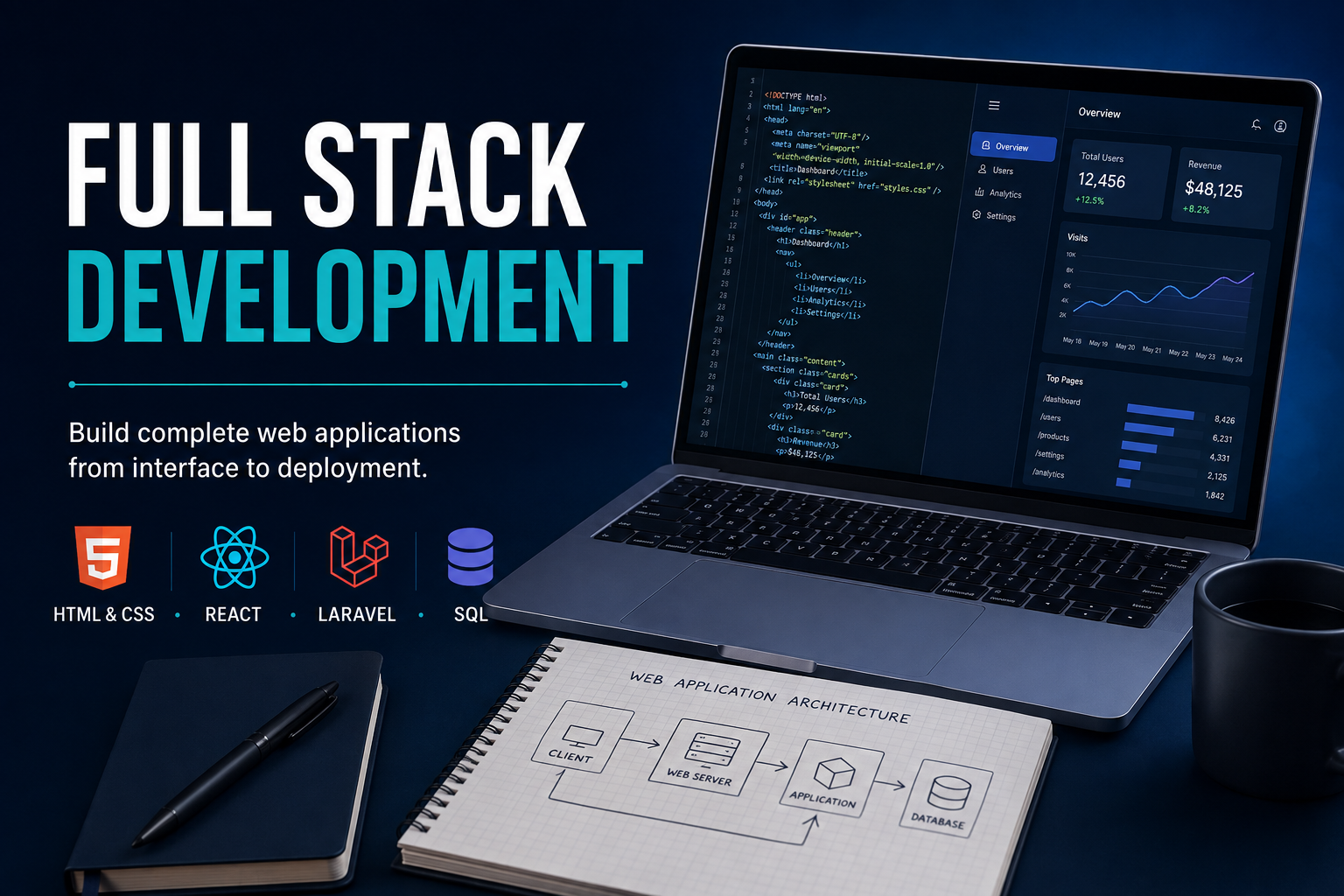
End-to-end web development covering front-end, back-end, databases, and deployment. Across 24 modules you move from writing your first HTML page to shipping a complete, authenticated, database-backed application that you designed and built yourself.
The course is sequenced so that nothing is treated as magic. You learn HTML and CSS before touching a framework. You learn JavaScript fundamentals and the DOM before React. You learn SQL and relational modelling before an ORM abstracts it away. By the time you reach the capstone, every layer of the stack is something you have already built by hand, which is what makes the difference between following a tutorial and being able to debug your own application at two in the morning.
Who this course is for
- Beginners with no prior programming background who want a structured route into web development rather than a scattered collection of tutorials
- Students and recent graduates in Assam and the Northeast who want portfolio work that stands up in an interview
- Career changers moving into software from another field
- Self-taught developers with gaps — often in databases, authentication, or deployment — who want the whole picture joined up
What you will build
Work is project-based throughout rather than saved for the end. You build responsive layouts from scratch, interactive interfaces with vanilla JavaScript, component-driven applications in React, REST APIs in Node and Express, and relational schemas in SQL. These come together in a final full stack application with real authentication, file uploads, tested code, and a live deployment.
You finish with deployed work you can show, and a GitHub history that demonstrates how you got there.
Course curriculum
Foundations — the web itself
- HTML & CSS Fundamentals
- Responsive Design & Flexbox/Grid
- JavaScript Fundamentals
- DOM Manipulation & Events
- Advanced JS: ES6+ & Fetch API
- Git & GitHub Workflow
Version control arrives early, in module six, rather than as an afterthought. Every project from this point forward is committed, branched, and pushed the way it would be on a working team.
Front-end engineering with React
- React Fundamentals
- React State & Component Composition
- React Hooks & Routing
React is introduced only after you can already build interactive interfaces without it, so that state, props, and re-rendering are understood as solutions to problems you have personally run into.
Back-end and APIs
- Node.js & Express Basics
- REST API Design
API design is treated as a design discipline, not just syntax — resource naming, status codes, error shapes, and the contract between client and server.
Data and persistence
- SQL & Relational Databases
- Database Design & ORM
- Authentication & Authorization
You write SQL before you use an ORM. Authentication is covered properly — sessions, tokens, password handling, and the difference between knowing who a user is and deciding what they may do.
Integration, quality, and delivery
- Full Stack Integration
- File Uploads & Middleware
- Testing Fundamentals
- Deployment & Environment Config
- Performance & Security Best Practices
Deployment and environment configuration are taught as core skills rather than a closing footnote. A great deal of real-world debugging happens at exactly this boundary.
Capstone and career
- Capstone Planning & Backend Build
- Capstone Frontend Integration
- Code Review & Refactoring
- Portfolio & Career Prep
- Final Project — Full Stack Application
The code review module matters more than its position suggests. Reading other people’s code, giving useful feedback, and acting on feedback about your own work are daily realities of the job and rarely practised before the first one.
Technologies you will work with
HTML5, CSS3, Flexbox and Grid, modern JavaScript (ES6+), the Fetch API, React with Hooks and client-side routing, Node.js, Express, SQL and relational database design, an ORM layer, Git and GitHub, and the tooling around testing, environment configuration, and deployment.
By the end of this course
- Build responsive, accessible interfaces without depending on a framework to do it for you
- Design and implement a REST API that other developers could actually consume
- Model relational data properly and query it in SQL
- Implement authentication and authorisation without copying it blindly from a tutorial
- Test, deploy, and configure an application across environments
- Read, review, and refactor code that you did not write
- Explain and defend every technical decision in your capstone project
Related courses at COMPLIT
If you want to go deeper on a single layer rather than across the whole stack, look at Front-End Development, Backend Master, and Database Architecture & Design. For interface and product thinking alongside the engineering, see UI/UX Design.
Browse everything on the COMPLIT courses page, or get in touch if you are unsure which course fits where you are now.